The Public Procurement Function: From an Operational Role to a Strategic Lever
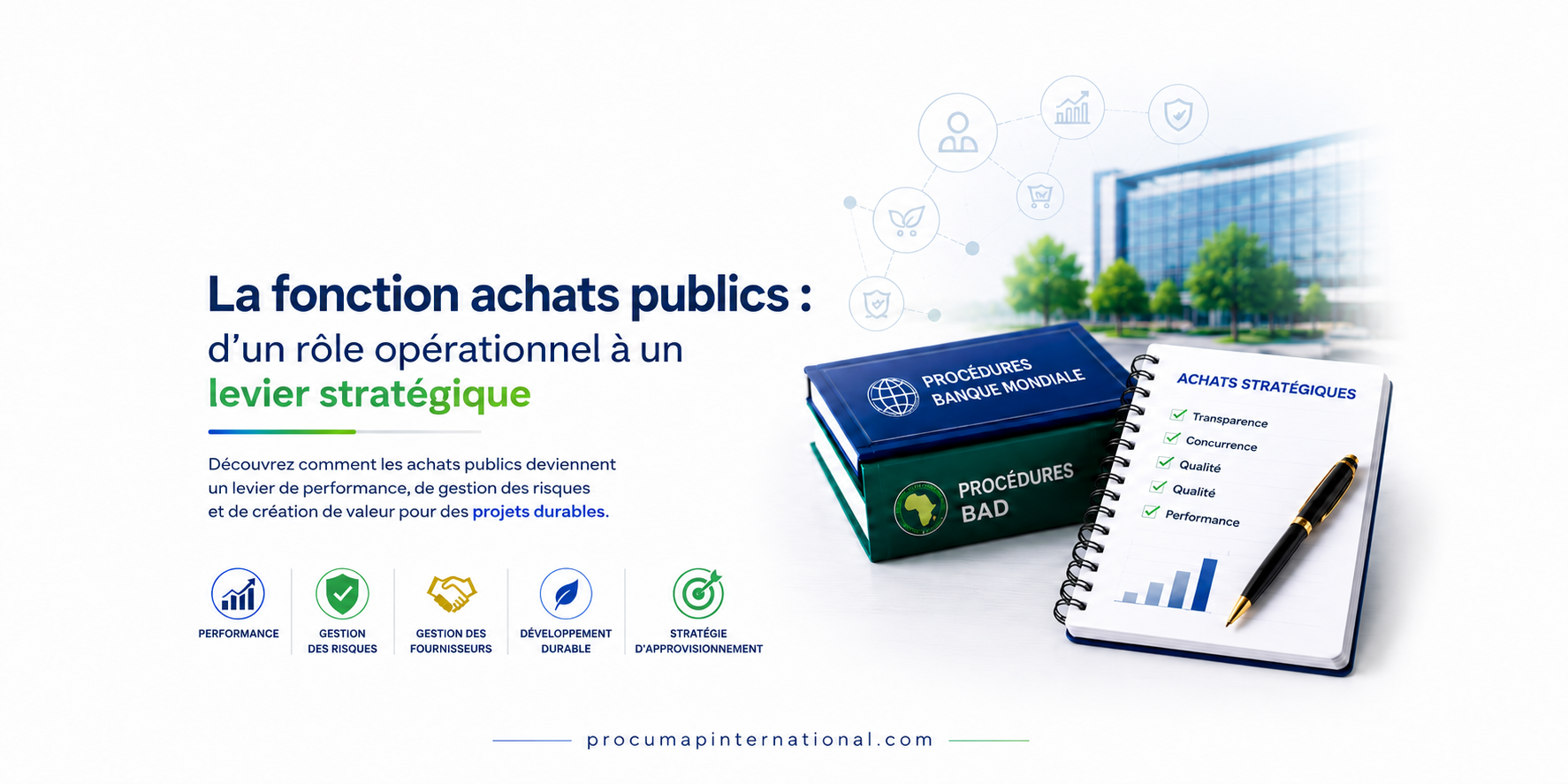
Good governance in public procurement is not a bureaucratic constraint. It is the lever that ensures public money truly reaches the citizen.
Introduction
I remember a project launch meeting somewhere in West Africa. The procurement specialist was called in at the last minute, the project was already planned, the budget allocated, the technical specifications locked. His role? Launch the tenders and ensure compliance.
I have lived that scene dozens of times. And each time, it illustrates the same fundamental problem: procurement arrives too late, does too little, and is treated as a formality rather than a lever.
Yet according to the OECD, public procurement accounts for an average of 13% of GDP and approximately 29% of public spending in member countries. In Africa, estimates range between 15% and 20% of GDP depending on the national context. These figures are not trivial, they mean that every public procurement decision directly impacts the quality of infrastructure, the effectiveness of public services, and the success of development projects.
So how do we move from this administrative, reactive vision to a strategic, proactive function that creates value? That is the central question of this article.
"Public procurement professionals are no longer simple procedure managers. They are becoming key actors in performance, governance, and project success."
1. A Function Historically Centered on Compliance
Let us be honest: the priority given to compliance is not a flaw in itself. Public procurement rests on fundamental principles that protect the public interest, transparency of procedures, equal treatment of candidates, free competition, sound use of public resources. These principles are non-negotiable.
The problem is not compliance. It is when compliance becomes the only obsession — at the expense of everything else.
When procedure eclipses strategy
I have observed the same symptoms of an overly procedural procurement function in many public organizations:
Procurement specialists are involved at the very end of the process, when everything has already been decided
Technical specifications are never truly analyzed; they are received and published as-is
Market risks are not anticipated; they are discovered during execution
Once the contract is signed, no one really monitors its implementation
The result? Procurement becomes an administrative step instead of a success factor. And projects pay the price of this reductive vision.
Concrete Example — Two Administrations, Two Approaches
❌ Administration A — Operational Approach
Poorly defines its needs from the outset
Systematically chooses the lowest price
Involves procurement only at the very end
Conducts no supplier market analysis
Result: delays, costly amendments, budget overruns, project delivered 18 months late.
✅ Administration B — Strategic Approach
Conducts an in-depth market analysis from the planning phase
Involves procurement from the very definition of needs
Evaluates total cost of ownership across the project lifecycle
Anticipates risks and integrates them into the contract
Result: project delivered on time, better quality, full cost control.
2. Why Is the Public Procurement Function Evolving?
This transformation is not the product of a management trend. It responds to concrete and pressing realities.
2.1. Increasingly Complex Projects
Public administrations no longer manage only simple purchases of supplies or small works. They now oversee multidimensional projects, road infrastructure, hospitals, schools, information systems, energy projects, programs financed by international donors. Each of these projects requires a tailored acquisition strategy. A mistake in the procurement phase can cost several months of delay and millions in overruns.
2.2. Increasing Pressure on Public Finances
In a constrained budget environment which is the case in virtually all African countries and many developed nations, every franc spent must produce maximum value. The objective is no longer to obtain the lowest price. It is to obtain the best value for money across the entire lifecycle. This approach fundamentally changes how contracts are evaluated and awarded.
2.3. Growing Exposure to Risks
Global supply chains have become more fragile. The COVID-19 pandemic, geopolitical tensions, commodity crises, all of these brutally reminded us that supplier risks are real. Organizations without a solid procurement strategy bore the full brunt of these shocks. Today, risk management is at the heart of the procurement function.
2.4. New Expectations Around Sustainable Development
Citizens, donors, and governments now expect public spending to also serve societal objectives — environmental protection, social inclusion, local economic development, innovation. Public procurement has become an instrument of public policy. Ignoring this dimension means missing a major opportunity.
3. Public Procurement as a Strategic Lever
Transforming the procurement function is first and foremost a philosophical shift. We move from "how do we comply with the rules" to "how do we create value." This may seem subtle, it changes everything in practice.
3.1. A Direct Contribution to Organizational Strategy
A high-performing procurement function does not merely execute orders. It contributes to achieving institutional objectives, project success, improvement of public services, and optimization of resources. It moves from cost center to value creator.
3.2. Total Cost Rather Than Purchase Price
The acquisition price is often only a fraction of the real cost. The best-performing organizations now analyze Total Cost of Ownership (TCO): purchase cost, installation, operation, maintenance, risks, and end-of-life costs. This approach leads to more durable and economically sound decisions.
3.3. Suppliers as Partners, Not Just Vendors
The vision of the supplier as a simple contractor is outdated. In a strategic approach, suppliers become performance partners, regularly evaluated, tracked against precise indicators, integrated into a continuous improvement logic. A well-managed supplier relationship considerably reduces execution risks.
3.4. A Central Role in Risk Management
The strategic procurement specialist intervenes from the planning phase to identify market risks, technical, financial, contractual, and environmental risks. This anticipation allows the acquisition strategy to be adapted before the procedure is launched not after the contract has been signed.
4. How to Transform the Procurement Function?
Integrate procurement from the planning stage
Transformation starts here. The best results are achieved when procurement specialists participate from the very definition of needs, market analysis, choice of acquisition strategy, and risk assessment. This early involvement significantly improves the quality of tender documents.
This is at the heart of the Project Procurement Strategy for Development (PPSD) used by the World Bank which recommends an in-depth analysis of the market, risks, and project objectives before launching any procedure. Organizations that apply this logic gain credibility with donors and considerably reduce their no-objection turnaround times.
Develop a clear procurement strategy
A strategic function rests on a defined vision, measurable objectives, an acquisition program, a supplier policy, and performance indicators. Planning becomes a management tool not an administrative obligation filled to satisfy an auditor.
Professionalize the teams
Expected competencies have evolved deeply. The modern procurement specialist can no longer rely solely on mastering regulatory texts. They must understand economic analysis, negotiation, risk management, project management, and data analysis. They become multidisciplinary professionals a strategic advisor as much as a technician.
Digitalize processes
Electronic platforms, dashboards, and monitoring tools enable better traceability, reduced timelines, increased transparency, and more effective contract management. Digitalization is not an end in itself, but it is a powerful accelerator when it rests on trained teams and clear processes.
Strengthen governance
A strategic procurement function must be fully integrated into the organization's governance into investment decisions, steering committees, strategic planning, and institutional risk management. As long as procurement remains confined to an administrative directorate with no link to strategy, transformation remains superficial.
5. The Concrete Benefits of a Strategic Procurement Function
Organizations that make this choice do not regret it. The results are tangible and measurable.
Financial performance
Optimization of public spending and reduction of hidden costs
Better allocation of public resources
Reduction of budget overruns
Quality of deliverables
Better selected and better monitored suppliers
More reliable and more compliant services
Higher satisfaction among end users
Risk management
Anticipation of difficulties before they arise
Better contract management
Reduction of disputes and litigation
Overall project performance
Projects are delivered on time, with better cost control and in line with initial objectives. This result strengthens the credibility of public institutions with citizens, partners, and international donors.
6. The Mistakes That Still Hold Transformation Back
I still see them too often. Despite all the evolution, certain practices continue to limit public procurement performance:
Getting involved only after the entire project has already been defined
Systematically choosing the lowest price without total cost analysis
Neglecting supplier market analysis before launching a tender
Treating the contract as finished the moment it is signed
Never measuring supplier performance
Underestimating contractual and operational risks
These are not minor details. They prevent procurement from playing its full strategic role — and often cost far more than the apparent savings they seem to generate.
Conclusion
Organizations that still regard public procurement as a simple administrative function risk missing out on a powerful performance lever. Conversely, those that invest in a strategic procurement function build more resilient, more effective projects that create lasting value for citizens.
This transformation cannot be decreed. It is built, through team training, process clarity, quality tools, and above all a cultural shift. A shift that often begins with a single decision: to involve procurement from day one of a project.
"Strategic procurement today builds the high-performing projects of tomorrow."
What about you?
Does your organization still consider procurement an administrative function or a true strategic lever? Contact Procumap International to exchange on best practices.
About Procumap International
Procumap International supports public administrations, businesses, and international organizations in transforming their procurement and sourcing function through advisory, training, and capacity-building services in public procurement, sourcing strategy, governance, and project management.
procumapinternational.com
#PublicProcurement #StrategicSourcing #Governance #PPSD #AfricaDevelopment #ProcumapInternational
Armand Tehia
Armand Tehia, PMP®, CPPB® Senior Public Procurement Specialist & Project Management Professional
Continue Reading
All articles
Good Governance in Public Procurement: An Essential Lever for Sustainable Development in Africa
12/06/2026
World Bank vs AfDB: what’s really changing in procurement
04/06/2026
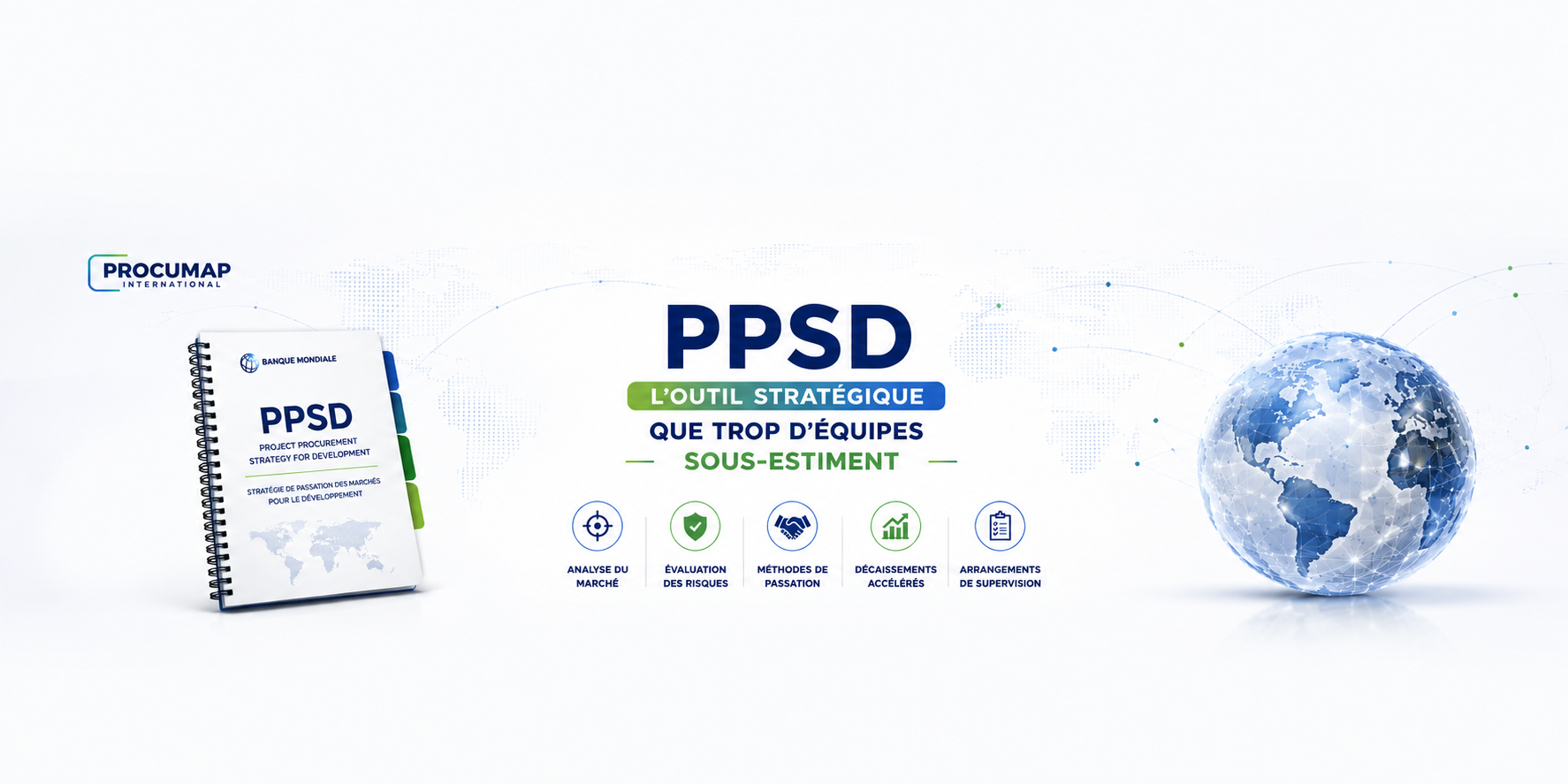
La PPSD : l'outil que la Banque Mondiale vous oblige à maîtriser — et que personne ne vous explique vraiment
04/06/2026